Panama City was named for the Panama Canal and elected its first mayor in February 1909. Nine National Register listings, state markers and museums.
Last checked Oct. 9, 2026. Sources: the Florida Department of State’s historical markers, the National Park Service’s National Register of Historic Places listed-properties file of May 22, 2026, Bay County’s History of Bay County and the City of Panama City’s About Panama City and Fire Department history pages.
Panama City grew from a land company’s town site on St. Andrews Bay into the seat of a new county within a few years. Its name looks south: the railroad that made the town was meant to be Atlanta’s outlet to the Panama Canal.
Who to call
- Florida historical markers: Florida Division of Historical Resources, markers.flheritage.com
- Science and Discovery Center of Northwest Florida: 850-769-6128
- City history and arts questions: City Hall, 850-872-3000
How the town began
- 1887-1888: developers George W. Jenks and C.J. Demorest set aside a downtown block as a park and platted a town around it, named “Park Resort,” on May 23, 1888, according to the state marker in what is now McKenzie Park.
- 1902-1906: Robert Lee McKenzie, a Georgia native in the naval stores business, organized the Gulf Coast Development Company to build a town site. In 1906 he persuaded J.B. Steele of Atlanta to end his new railroad from Dothan, Alabama, on the company’s land. Steele said, “I want this to be Atlanta’s outlet to the Panama Canal,” and the name followed.
- February 1909: McKenzie was elected mayor of Panama City, the city’s first.
- 1912: the city formed one of the first volunteer fire departments in the area, with two hand-drawn hose carts.
- July 1, 1913: the Legislature created Bay County from parts of Washington, Calhoun and Walton counties. Panama City hosted the celebration, called Natal Day, in the downtown park.
- 1914-1915: the Bay County Courthouse was built; it was gutted by fire in December 1920 and rebuilt, and it is still in use.
- 1964: the downtown park, once Magnolia Park, was renamed McKenzie Park on Dec. 4.
Before the town, the bay was home to the St. Andrew Bay Saltworks, one of the South’s largest salt producers during the Civil War. Union attacks in 1862 and 1863 destroyed more than 290 saltworks, which were rebuilt and ran until February 1865, the state marker says.
National Register of Historic Places
The National Park Service’s file lists nine National Register properties with a Panama City address:
| Property | Address | Listed |
|---|---|---|
| Robert L. McKenzie House | 17 E. Third Ct. | Aug. 21, 1986 |
| St. Andrew School | 3001 W. 15th St. | Aug. 14, 1997 |
| Sherman Arcade | 228 Harrison Ave. | Sept. 9, 1998 |
| SS Tarpon shipwreck | 7.8 nautical miles offshore | May 31, 2001 |
| Schmidt-Godert Farm | 100 FL 2297 | Oct. 4, 2002 |
| Sapp House | 224 Third Ct. | Oct. 4, 2003 |
| A.A. Payne-John Christo Sr. House | 940 W. Beach Drive | July 16, 2008 |
| Panama Grammar School | 101 E. Seventh St. | Jan. 21, 2020 |
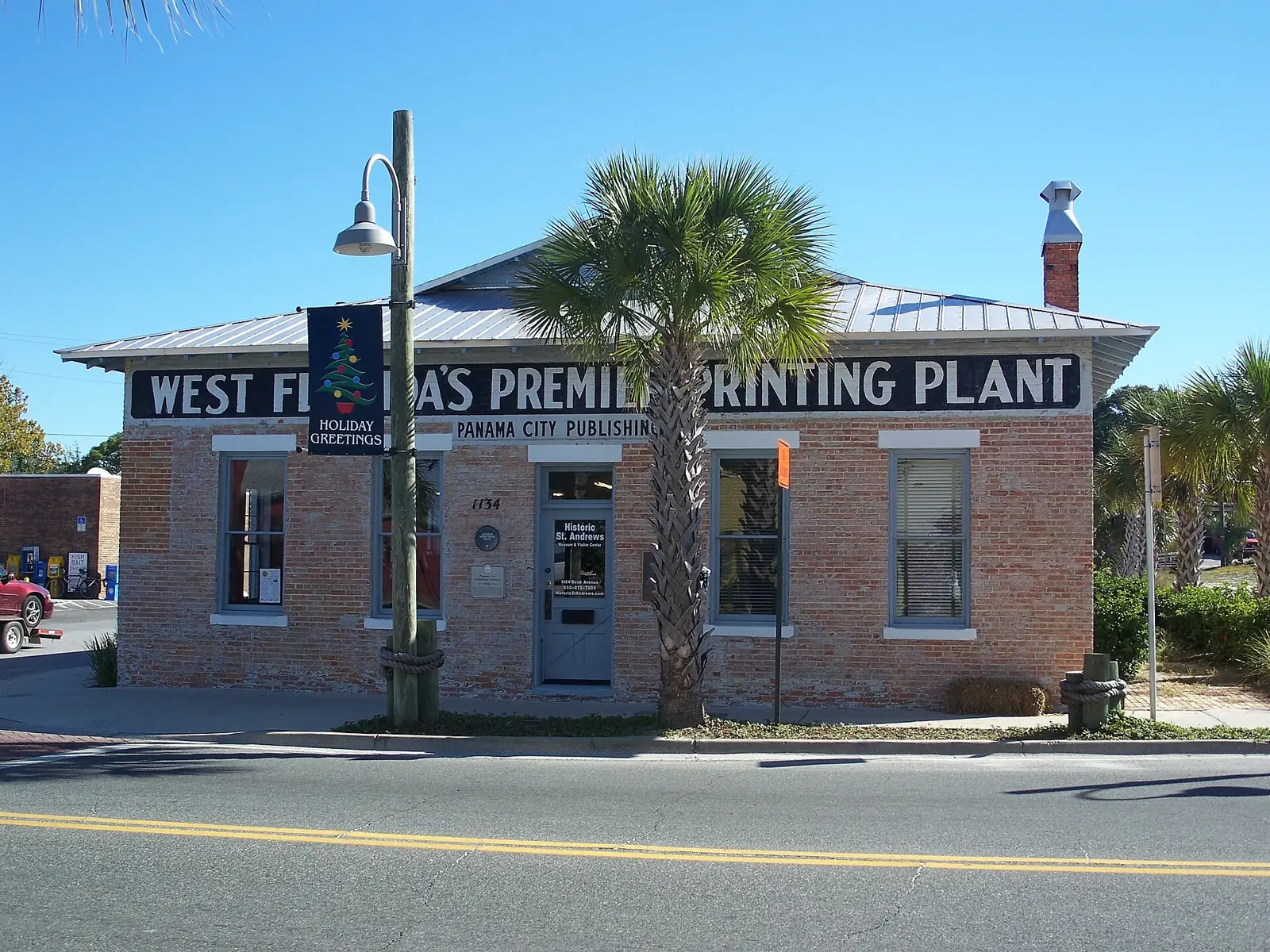
| Panama City Publishing Company Building | 1134 Beck Ave. | July 20, 2021 |
Two more Bay County listings, the Camp Helen Historic District and the Latimer Cabin, are in Panama City Beach.
State historical markers
Florida has placed markers at these Panama City sites, among others:
- Robert Lee McKenzie’s home and office, Third Court at Park Street (1987)
- McKenzie Park, Park Avenue at East Oak Avenue (2023)
- The Gideon v. Wainwright case, 300 E. Fourth St., at the Bay County Courthouse (2003). Clarence Earl Gideon was tried here in 1961 without a lawyer; the U.S. Supreme Court’s 1963 ruling in his case guaranteed poor defendants a lawyer in serious criminal cases. Panama City attorney W. Fred Turner won his acquittal at retrial.
- Rosenwald High School, 924 Bay Ave. (2020), on the school built for Black students under the Rosenwald Fund program, which graduated its first class of three in 1939.
- St. Andrew(s) School, 3001 W. 15th St. (2007)
- The St. Andrew Bay Saltworks, West Beach Drive at East Caroline Boulevard (2003)
- St. Andrews Bay skirmish, U.S. 98 between Fairland and Friendship avenues (1961)
- John Christo Sr., West Beach Drive near Balboa Avenue (2009)
Read each marker’s full text on the state’s marker site.
Museums and history to visit
The city lists the Panama City Publishing Company Museum, in the 1134 Beck Ave. building on the National Register, the Science and Discovery Center of Northwest Florida and the Bay County Historical Museum among its museums. The Science and Discovery Center lists its hours as 10 a.m. to 4 p.m. Tuesday through Saturday. Check the others’ hours before you go; we could not confirm them from their own sites.
The city’s Mural Trail runs from St. Andrews through downtown to Millville, with more than 15 outdoor works, the city says.
What this means for you
- For a self-guided walk, start at McKenzie Park and the McKenzie House marker across the street, then head to the Gideon marker at the courthouse on Fourth Street.
- Read the full marker texts on the state’s marker site before you go.
Related: Panama City population and growth, parks and trails and things to do this month.
Frequently asked questions
How did Panama City, Florida, get its name?
From the Panama Canal. Railroad builder J.B. Steele, persuaded by Robert Lee McKenzie to end his line from Dothan here, said he wanted it to be Atlanta’s outlet to the Panama Canal, according to the state historical marker at the McKenzie House.
Who was the first mayor of Panama City?
Robert Lee McKenzie, elected in February 1909. The downtown park was renamed McKenzie Park in his honor on Dec. 4, 1964.
What places in Panama City are on the National Register of Historic Places?
Nine: the McKenzie House, St. Andrew School, Sherman Arcade, the SS Tarpon shipwreck, the Schmidt-Godert Farm, the Sapp House, the Payne-Christo House, Panama Grammar School and the Panama City Publishing Company Building.
What happened in Panama City in the Gideon v. Wainwright case?
Clarence Earl Gideon was tried in the Bay County Courthouse in 1961 without a lawyer. The U.S. Supreme Court ruled in 1963 that poor defendants charged with serious crimes must be given one, and he was acquitted at retrial with a Panama City attorney.
Have your say