Panama City kept its 2026 tax rate at 4.7999 mills, 2.57% above rollback. Bay County bills go out by Nov. 1 with a 4% discount in November.
Last checked Oct. 9, 2026. Sources: the Bay County Tax Collector, the Bay County Property Appraiser, and the City of Panama City’s Resolution 20260922.3 setting the 2026 rate.
Three offices touch your property tax bill in Panama City. The Bay County Property Appraiser sets your property’s value and grants exemptions such as homestead. Taxing bodies, including the City Commission, the County Commission and the School Board, set the rates. The Bay County Tax Collector mails the bill and takes payment.
Who to call
- Property Appraiser (values, homestead, exemptions): 850-248-8401, 860 W. 11th St., Panama City, 8 a.m. to 4:30 p.m. weekdays
- Tax Collector (bills, payment, installment plan): 850-248-8501, pay online
- City of Panama City (city budget and rate): City Hall, 850-872-3000
- Official pages: property search, tax estimator and exemptions
The city’s rate for 2026
The Panama City Commission adopted a final operating rate of 4.7999 mills for the 2026 tax year on Sept. 22, 2026, the same rate the city levied in 2025. A mill is $1 of tax for every $1,000 of taxable value. Property in the Downtown Improvement District also pays 3.0000 mills to that district.
Because values rose, the same rate brings in more money. The city’s resolution says the combined rate of 4.8609 mills is 2.57% above the rolled-back rate of 4.7393 mills, the rate that would have raised the same revenue as last year. The tentative rate passed 5-0 at the first budget hearing on Sept. 8, according to the meeting minutes.
What else is on the bill
The city’s rate is only part of your bill. The tax collector’s millage table shows the rates on the 2025 bills, the most recent it has posted:
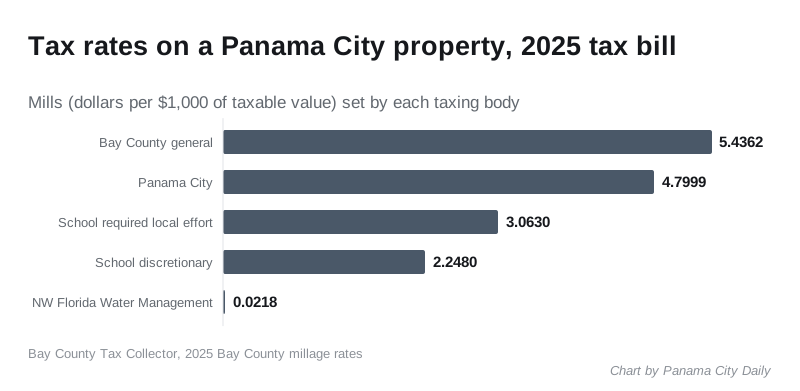
Your 2026 rates for every taxing body are printed on the TRIM notice mailed in August and on the November bill. Bills can also carry non-ad valorem assessments, flat charges for services such as stormwater, paving and solid waste.
One that surprises new owners is the city’s fire services assessment. The City Commission approved it in 2020 to pay for about 55% of the Fire Department’s budget. The city’s explainer lists $300 per dwelling unit for non-homestead homes and $150 for homesteaded homes. Government property is exempt, and qualifying homesteaded seniors and veterans are exempt or pay less. Questions go to cityattorney@panamacity.gov.
When taxes are due
Bills are mailed on or before Nov. 1 and are due by March 31. Pay early for a discount:
| Paid in | Discount |
|---|---|
| November | 4% |
| December | 3% |
| January | 2% |
| February | 1% |
| March | None |
Taxes unpaid on April 1 are delinquent and draw a penalty; delinquent taxes must be paid in certified funds. Mailed payments get the discount for the month of the postmark.
Pay quarterly instead. If last year’s taxes were more than $100, you can join the installment plan. Apply by April 30; the first payment is due by June 30, with discounts of 6%, 4.5% and 3% on the first three installments.
Homestead and other exemptions
If you own your home and it was your permanent residence on Jan. 1, apply for homestead by March 1. The exemption is worth up to $50,000 of assessed value. The first application is made in person or online with the property appraiser; bring your recorded deed, Social Security numbers for all owners, a Florida driver’s license and vehicle registration showing the address, according to the appraiser’s exemptions page.
Once you have homestead, the Save Our Homes cap limits yearly increases in assessed value to 3% or the change in the Consumer Price Index, whichever is less. Moving within Florida? Portability lets you carry up to $500,000 of that benefit to a new homestead within three years.
Other exemptions cover seniors, widows and widowers, blind and disabled residents, disabled veterans and surviving spouses of first responders. The deadline for all of them is March 1.
How to appeal your value
Your value is set as of Jan. 1. The TRIM notice of proposed taxes is mailed by Aug. 24, and the property appraiser’s appraisal calendar gives you 25 days after it is mailed to act:
- Call or visit the property appraiser’s office, 850-248-8401, to talk through your value or exemptions. Most questions end here.
- If you still disagree, file a petition with the Value Adjustment Board by the 25th day after the TRIM notice was mailed.
- You can also contest an assessment in circuit court under Section 194.171, Florida Statutes.
For the 2026 tax year that window has closed; the next one opens with the TRIM notices in August 2027.
What this means for you
- The city’s rate did not change, but a higher value can still mean a higher city tax.
- Pay in November for the full 4% discount.
- Bought a home this year? File for homestead by March 1 for 2027.
Related: Panama City home prices, moving to Panama City and who to call at City Hall.
Frequently asked questions
When are Bay County property taxes due?
Bills are mailed on or before Nov. 1 and are due by March 31. Paying early earns a discount of 4% in November, 3% in December, 2% in January and 1% in February. Unpaid taxes become delinquent April 1.
What is the Panama City millage rate for 2026?
The City Commission adopted 4.7999 mills on Sept. 22, 2026, the same rate as 2025. It is 2.57% above the rolled-back rate, so it counts as a tax increase under Florida law.
What is the homestead exemption deadline in Bay County?
March 1. You must own and live in the home as your permanent residence on Jan. 1, and the first application is made in person or online with the Bay County Property Appraiser.
How do I appeal my property value in Bay County?
Talk to the property appraiser’s office first, at 850-248-8401. If you still disagree, file a petition with the Value Adjustment Board by the 25th day after your TRIM notice was mailed.
What is the Panama City fire assessment on my tax bill?
A non-ad valorem charge the City Commission approved in 2020 to fund the Fire Department: $300 per dwelling unit for non-homestead homes and $150 for homesteaded homes, with some exemptions.
Have your say